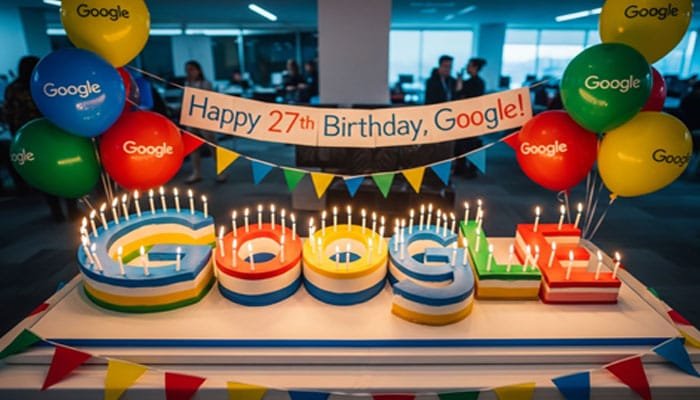
On September 27, 2025, Google marked its 27th birthday- a celebration not just of a company, but of a technological revolution that transformed how we access and interact with information. Although, it is one of the best search engines in the world. It leads the global search trends and entire concept of search engine optimization surrounds Google Search. Most interestingly, it also offers Google Trends which showcases what people are looking for around the world.
With time, Google has also transformed into a global giant. It has entered into versatile businesses in the last few years. Often, the company is vast than a government even. For instance, Google signed nuclear energy deal for its data centers in October 2024. Still, it also faces several controversies & challenges in its journey. Google has faced Legal Setback in Antitrust Cases over the past few years.
This report traces Google’s journey from its inception to the present, exploring key historical events, innovations, challenges, and the road ahead. While its official incorporation occurred earlier in the month, September 27 has become a symbolic day to reflect on Google’s growth and global impact.
Founding & Early History
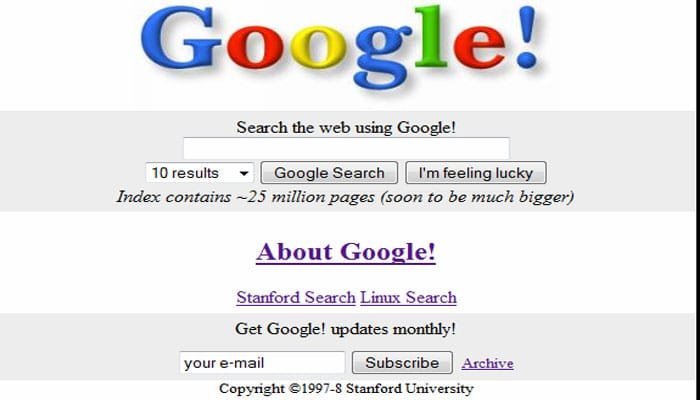
The origins of Google date back to 1996 when Larry Page and Sergey Brin, both PhD students at Stanford University, began a research project known as BackRub. This early effort focused on analyzing the web’s link structure to improve information retrieval. In 1998, the duo formally founded Google Inc., operating out of a garage in Menlo Park, California. The company was officially incorporated on September 4, 1998.
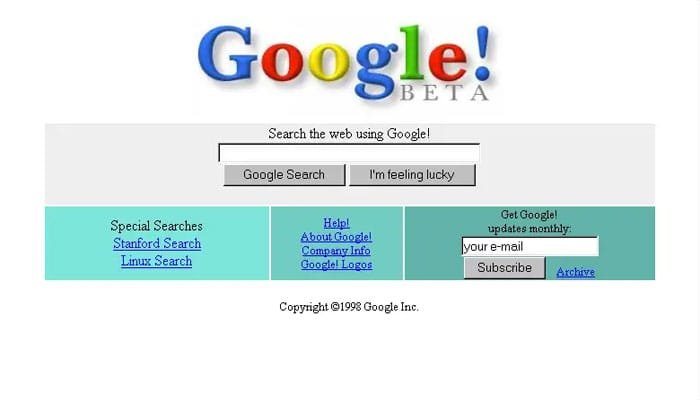
However, in its early years, Google shifted the celebration of its birthday to late September. Eventually, September 27 became the official symbolic date for annual commemorations, chosen in part to align with internal milestones such as major search indexing achievements.
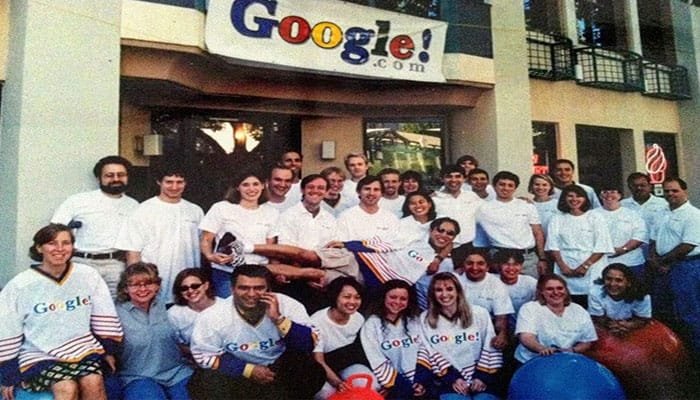
Google began rolling out products quickly in the early 2000s. In 2002, Google News was launched, followed by Gmail in 2004—the same year the company went public via IPO. Google Maps and the acquisition of Android came in 2005. In 2008, Google introduced its Chrome browser, and in 2011, it experimented with social networking through Google+, which was later discontinued. A major corporate restructuring took place in 2015, leading to the formation of Alphabet Inc., with Google becoming a subsidiary under this new holding company.
Why September 27 Became Google’s Celebrated Birthday
Though September 4, 1998, is Google’s legal birthday, the company has long preferred to mark September 27 as its anniversary. This choice reflects milestones such as breakthroughs in indexing scale, which coincided with late September dates. Additionally, the adoption of September 27 was reinforced by Google’s use of birthday-themed Doodles on that day in subsequent years. In earlier years, Google had celebrated its birthday on other dates in September, such as the 7th and the 26th, before settling on the 27th as a consistent tradition. This decision also helped strengthen public recognition and branding.
Key Milestones & Google’s Evolution
Over the course of 27 years, Google evolved from a search engine into a comprehensive tech ecosystem. Early on, it expanded beyond search by launching services such as Gmail, Google News, Google Maps, and eventually acquiring YouTube and Android. These platforms redefined digital communication, navigation, content consumption, and mobile computing.
In terms of revenue, Google built its dominance on digital advertising. Search advertising, display networks, and YouTube monetization turned the company into one of the world’s largest tech corporations. Today, Google’s search engine is responsible for more than 70 percent of global search queries.
A defining moment came in 2015 with the creation of Alphabet Inc., a new corporate structure that allowed Google to focus on its core services while exploring experimental ventures such as Waymo (autonomous driving), Verily (life sciences), and DeepMind (artificial intelligence research).
Google also cultivated a unique visual and cultural identity. The original logo, designed by Ruth Kedar, established a colorful and approachable brand image. Google’s Doodles, especially on birthdays and commemorative days, have since become a recognizable form of digital expression.
In the last decade, Google’s technological innovation has focused on artificial intelligence. It has integrated AI into Search, Assistant, Gmail, Photos, and other services—laying the foundation for the next phase of human-computer interaction.
Celebrating the 27th Birthday 2025

For its 27th birthday in 2025, Googlepaid homage to its roots by showcasing a nostalgic version of its 1998 logo on the homepage. This visual callback was more than just a Doodle—it served as a reminder of how far the company had come from its humble beginnings.
Media coverage highlighted the story of Ruth Kedar, the designer behind the original logo, and celebrated Google’s rise from a research experiment to a global tech powerhouse. While many articles reflected on the company’s growth, they also noted the curious fact that September 4 is Google’s formal birthday. Nonetheless, the public continues to associate September 27 with the company’s legacy and progress.
The Impact & Significance of Google
Over the last 27 years, Google has become a cornerstone of the digital age. It has made information widely accessible, turning the internet into a practical tool for billions. Its search algorithms, notably PageRank, Panda, and BERT, have shaped the standards for content relevance, website design, and information retrieval.
Beyond its original scope, Google now operates an ecosystem that includes Gmail, Google Docs, Android, Chrome, Google Cloud, and much more. Its influence extends to education, business, healthcare, and entertainment. Economically, countless businesses rely on Google Ads for visibility, and entire digital marketing industries have grown around its tools.
Culturally, the verb “to google” has entered everyday language, symbolizing its integration into global consciousness.
Challenges & Criticisms
Google’s path has not been without obstacles. The company has faced recurring scrutiny over privacy and data handling practices. Critics argue that its data collection for ad targeting raises ethical and regulatory concerns. As Google operates at the intersection of business and information, the debate over surveillance, transparency, and user autonomy continues.
In recent years, Google has been the subject of antitrust investigations in the United States, European Union, and other regions. Regulators have questioned whether the company’s market dominance restricts competition and innovation. Concerns also exist over Google’s alleged prioritization of its own products within search results.
Furthermore, with its push into artificial intelligence, Google faces broader ethical challenges. These include algorithmic bias, job displacement, misinformation, and the need for transparent AI governance.
Looking Ahead: The Next Chapter
As Google steps into its 28th year, several trends and priorities are expected to shape its future.
The integration of artificial intelligence will deepen across products and services. Search is shifting toward more conversational and generative models, reflecting users’ desire for intelligent assistance rather than keyword-based answers. Google Assistant and Workspace apps are also expected to evolve with generative AI features that support creativity, productivity, and collaboration.
Augmented reality and spatial computing could be key focus areas as Google explores beyond the screen. With increased competition from Apple and Meta in AR and mixed reality, Google may revisit its earlier ambitions in this domain.
Privacy is likely to become a more central theme. In response to regulatory and consumer demand, Google is investing in on-device AI, differential privacy, and more user-controlled data environments.
Google Cloud is another area of growth, as enterprise adoption of AI and cloud computing continues. Competing with Amazon AWS and Microsoft Azure, Google may double down on its AI-native infrastructure.
Under Alphabet, moonshot projects in areas such as quantum computing, health sciences, and robotics could deliver long-term breakthroughs. At the same time, sustainability initiatives around data center energy use and carbon neutrality will remain a priority in a climate-conscious era.
Commemorative Message
Dear Google, Happy 27th Birthday.
From your early days in a Stanford garage to becoming a pillar of the global digital ecosystem, your journey has redefined how people find, share, and create knowledge. You’ve made the world’s information not only accessible but also useful, intuitive, and dynamic. As you reflect on this milestone, we celebrate your past, recognize your present, and look ahead to the future. May the years ahead be as impactful, innovative, and inclusive as the ones that brought us here.