
High Voltage Sodium Battery may offer solution for everyone around the world. Lithium-ion has run the show for three decades. It is in your phone, your car, and increasingly in your garage. But lithium is not cheap, and it is not evenly distributed around the world. Most of the world’s supply sits in a handful of countries, which makes prices and politics both volatile. The world is changing with solar solutions such as solar power banks, solar panels and planes. However, the rare availibility of lithium is a major concern.
That is the gap sodium is stepping into. It is the same element sitting in your kitchen salt shaker.
It is nearly everywhere on Earth, and until recently it just could not hit the voltage lithium could. That has changed. High voltage sodium batteries are now closing that performance gap fast enough that companies from CATL to a small German startup called Revolta are betting real money on it. Today’s world needs cheaper, safer, and smarter energy storage more urgently than ever before and these sodium batteries are leading the way.
What is a High Voltage Sodium Battery?
A high voltage sodium battery is an energy storage device that uses sodium ions to carry electrical charge. Instead of lithium it relies on sodium, which is the same element found in ordinary table salt. Sodium is one of the most abundant elements on Earth that is found easily in soil, oceans, and rocks everywhere. If we look at the “high voltage” part it means that these batteries are specially designed to operate at elevated high voltage levels efficiently. Higher voltage means that more energy is packed into fewer cells which makes the whole system more efficient and compact.
Traditional sodium-ion batteries operated at around 3.0 volts, which was lower than lithium-ion batteries 3.7 volts. Engineers and researchers have been working hard to push sodium batteries to generate a higher voltage in recent years. New materials and designs now allow sodium batteries to reach voltage levels that almost match or challenge lithium systems. Companies like BYD have even developed sodium cells reaching a nominal voltage of 1,200 volts for large energy storage systems. They also developed world’s first high performance sodium-ion BESS (Battery energy Storage System) product.
How the Sodium Ions Generate Electricity?
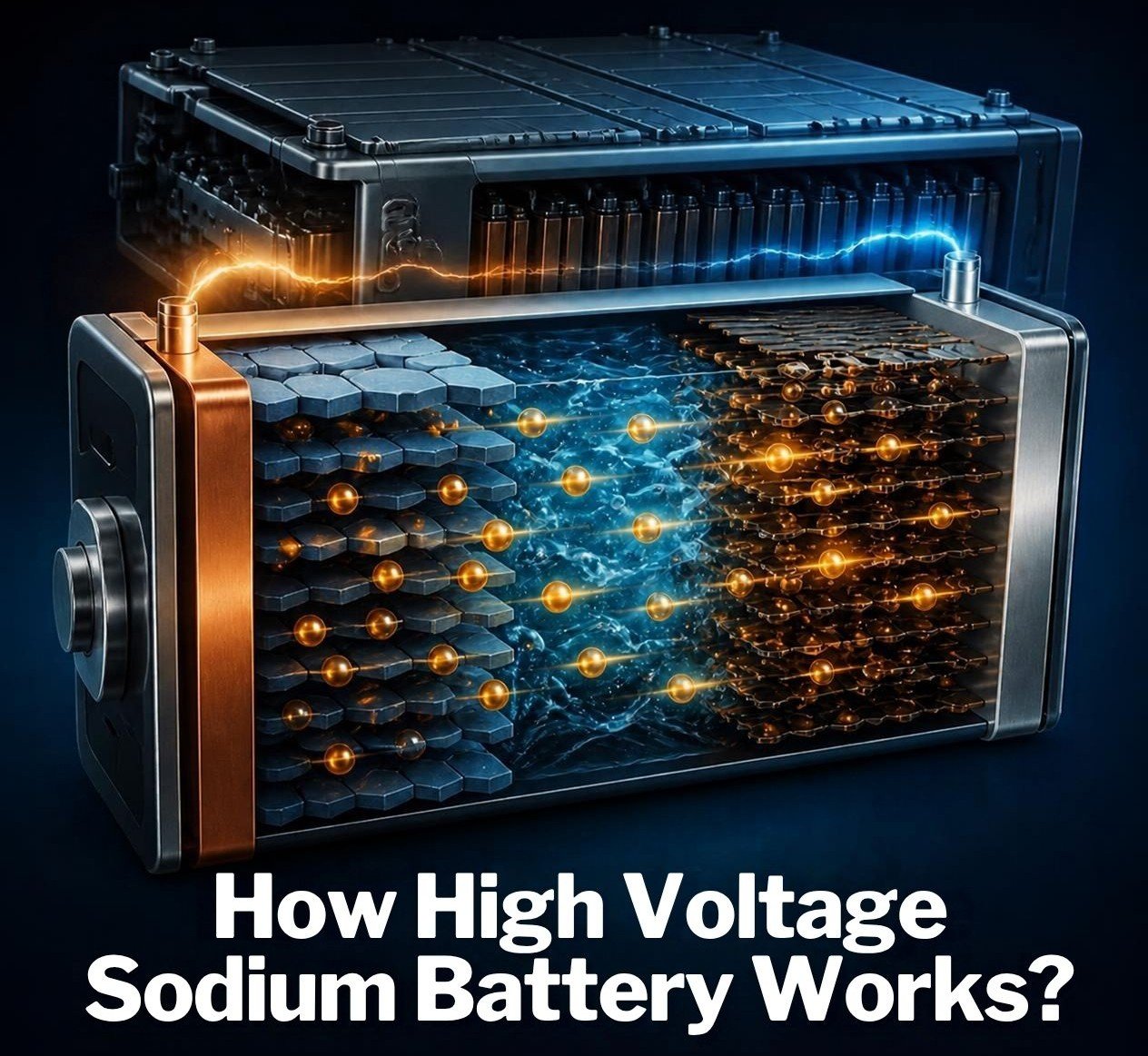
To understand the sodium-ion battery, we first need to know how any rechargeable battery actually works inside. Every battery has three main parts; a positive electrode called the cathode, a negative electrode called the anode, and a liquid or solid electrolyte sitting between them. The electrolyte acts like a highway that allows charged particles called ions to travel freely back and forth. In sodium batteries, the travelling particles are sodium ions that carry a positive charge.
When we charge a sodium battery, sodium ions leave the cathode that is a positive electrode and travel through the electrolyte. They then settle into the anode material, where they are stored until the battery is needed. When the battery discharges and powers a device, those sodium ions flow back towards the cathode through the electrolyte. At the same time, electrons travel through the external circuit and produce the electricity you use. This constant back and forth movement of ions is what makes the battery rechargeable again and again. The process is clean, repeatable, and highly efficient when the right materials are used. It is also cost friendly as compared to lithium-ion because of its abundance.
What Makes the Voltage High: Cathode, Anode and Electrolytes
Getting a sodium battery to operate at high voltage is not simple and requires very specific materials. The cathode material is the most important factor in determining how high the voltage can go. Three main types of cathode materials are used today in modern sodium battery research and production.
The first type is called layered oxide cathodes, which use metals like nickel and manganese arranged in layers. These materials allow sodium ions to slide in and out of the structure easily during each charge cycle. The second type is called Prussian Blue Analogues, which look like a simple cage structure made from common metals. This type is extremely cheap to make and works well at moderate to high voltage levels. The third type is called polyanionic compounds, which includes materials like sodium vanadium phosphate and related variants. These are known for very stable structures that hold their shape even under high voltage and repeated cycling stress.
The anode side also matters greatly for achieving high voltage performance and long life. Regular graphite which is used in lithium-ion anodes, does not work well with sodium ions at all. Sodium ions are physically larger than lithium ions and cannot squeeze into graphite’s tight structure effectively. So researchers developed hard carbon anodes, made from materials like coconut shells or sugar, which have more open spaces. This open structure gives sodium ions room to move in and out and settle without damaging the electrode over time.
The Electrolyte Works as an Invisible Highway Inside the Battery
The electrolyte is the liquid or solid material sitting in the battery between the two electrodes and it plays a critical role. In high voltage sodium batteries, the electrolyte must stay stable even when the voltage is pushed very high. Standard electrolytes tend to break down at higher voltages, which degrades and weakens the battery very quickly. Researchers have developed special formulations called weakly solvating electrolytes that are more stable at high voltage.
One key challenge unique to sodium batteries is something called aluminum current collector corrosion. Unlike lithium batteries, sodium electrolytes can damage aluminum metal when voltage rises above 3.8 volts. Scientists have solved this by adding special phosphite additives that create a thin protective layer on the aluminum surface. This tiny protective film stops the corrosion and allows the battery to run at high voltage safely for longer.
A protective nanoscale layer also forms naturally on both electrodes during early charge cycles. This layer is called the Solid Electrolyte Interphase on the anode and the Cathode Electrolyte Interphase on the other side and it is very crucial. The quality matters a lot. A good quality layer acts like an armor, protecting the electrode surface from further electrolyte damage each cycle.
How High Voltage Boosts Energy Density
Energy density tells us how much energy can be stored in a given size or weight of battery. Higher voltage directly increases energy density because more work gets done with the same amount of charge moving. If we look at it, it is just like water pressure in a pipe higher pressure means more power delivered through the same pipe size. This is why engineers are so focused on pushing sodium batteries to higher and higher operating voltages.
Recent research from the University of California San Diego showed a modified sodium cathode that stayed stable under high voltage conditions. The team used a supercomputer and AI models to simulate how sodium ions move through the crystal structure at the atomic level. They discovered that small tweaks to the material’s chemistry could dramatically improve both capacity and stability at higher voltages. Professor Shirley Meng also noted that the improved cathode held more charge and kept most capacity even after many tough cycling rounds. This kind of research is helpful in decreasing the energy density gap between sodium and lithium batteries faster than expected.
CATL’s second-generation sodium-ion cells now achieve 175 watt-hours per kilogram, which is comparable to lithium iron phosphate batteries. BYD’s research cells using a blade battery architecture have reached an impressive operating voltage range of 800 to 1,400 volts. These numbers show just how far sodium battery technology has come in only a few short years of serious development.
The Lifespan of Sodium-ion Batteries
The Sodium-ion batteries have a very high rate of cycles. You just need to make sure that you take care of these few things to maximize the batteries lifespan and energy storage. The first thing is avoiding 100 percent battery charge because it might cause tension on the working electrodes. The charge level should be 80-90 percent for better battery health. Secondly, avoiding 0% battery discharge as it might affect your battery too, as this way more pressure would fall on internal parts. One should keep the battery up to 10-20 percent so that there is no strain on battery.
Thirdly, batteries should be charged at optimal temperatures that are not too hot and not too cold. And lastly, electrode and electrolyte material quality matters too; unstable anode, cathode, and electrolyte materials can limit the number of cycles a battery can performs. The higher the material quality, the more consistent the long-term performancev of High Voltage Sodium Battery. So, if you keep a check on all these points you can maximize your battery’s health and it can perform 2000-4000 cycles easily.
The Revolta Home Battery System
The clearest sign that this technology has left the lab is a product launch. In June 2026, German startup Revolta AG introduced what it describes as the first high-voltage sodium battery system built specifically for residential and rooftop solar use, unveiling it at Intersolar Europe in Munich, according to coverage from Renewables Now and other outlets. The system uses a proprietary transformer that boosts voltage output by roughly fifty times, which lets each module run on just three sodium-ion cells rather than the many cells a conventional design would need. A starting module holds 2.2 kilowatt-hours and scales up to 22 kilowatt-hours.
Per reporting on the product, it runs at a nominal 450 volts DC with over 95 percent efficiency and an energy density of roughly 105 watt-hours per kilogram, and carries IP65 dust- and water-resistance for outdoor installation. Whatever its eventual commercial success, it signals that high-voltage sodium technology is now a shipping product, not just a research paper.
Why Sodium Instead of Lithium?
People often wonder why anyone would bother with sodium when lithium has already proven itself so well. The answer comes down to cost, availability, safety, and performance in specific conditions that matter a great deal. Sodium carbonate the raw material for sodium batteries costs just $0.05 per kilogram on global markets currently. If we compare that to lithium carbonate which costs around $15 per kilogram, the economic advantage becomes very clear. That is a three hundred times difference in raw material cost, which eventually flows down into the price consumers pay.
Sodium is also the sixth most abundant element in the entire Earth’s crust, found almost everywhere in massive quantities. It is also found in great amounts in oceans and water for High Voltage Sodium Battery. There is no geographic concentration of sodium in a few politically sensitive countries the way lithium is concentrated. This means supply chains for sodium batteries are far more stable, secure, and better over the long term globally.
Beyond cost and supply, sodium batteries also perform much better than lithium in very cold temperatures. Experts note they work effectively from minus 40 degrees Celsius all the way up to positive 70 degrees Celsius reliably. While lithium batteries struggle badly below zero degrees, which is a serious limitation for cold climate countries and applications.
Another important safety point is that sodium batteries are far less prone to catching fire or exploding violently. They do not use cobalt or nickel in the same way many lithium chemistries do, which also reduces ethical supply chain concerns significantly. In experiments such as independent nail penetration, crushing, and overcharging tests, sodium cells have shown no thermal runaway events at all.
Sodium Batteries and The Clean Energy Grid Connection
Perhaps the biggest opportunity for high voltage sodium batteries is not in phones or cars but in the power grid. It is the best source for generating current in larger power plants and systems. Storing electricity from solar and wind farms has been one of the hardest problems in the clean energy transition globally. Both solar panels and wind turbines have restrictions. Solar panels only generate power when the sun shines, and the same way wind turbines stop when the air is still and calm. Grid scale batteries can store that energy and release it hours later when demand is high but generation is low.
High voltage sodium batteries are extremely well suited for this specific role in grid energy storage. They can be charged and discharged tens of thousands of times without significant degradation of performance. BYD’s research cells have demonstrated more than 10,000 charge cycles with at least 80 percent capacity still retained afterward. Some systems from companies like Peak Energy already show lifespans of 20 years or more under real operating conditions. The IEA notes that 2026 could prove to be a pivotal year for sodium battery deployment at scale globally. CATL has committed to large scale deployment across vehicles, battery swapping stations, and grid storage systems this year.
Where Are These Batteries Being Used Right Now?
Sodium batteries are moving from lab to market fastest in China where CATL, BYD, and HiNa Battery are all pushing commercial products forward. A joint effort between Changan Automobile and CATL reportedly produced the world’s first mass produced sodium-ion passenger vehicle in February 2026. Scooter maker Yadea launched four sodium-ion two-wheeler models across Chinese cities in 2025, and Shenzhen has begun piloting sodium-ion-specific battery swap stations for commuters and delivery riders.
On the grid side, Peak Energy has reportedly deployed a 3.5 megawatt-hour installation at the SolarTAC facility in Colorado, and CATL and Beijing HyperStrong have signed a 60 gigawatt-hour supply agreement described as the largest sodium-ion storage deal announced to date. Industry forecasts cited in trade coverage project the sodium-ion market growing at roughly 27 percent annually over the next decade.
Current Challenges and What Scientists are Solving
No technology is perfect, and high voltage sodium batteries still face several real challenges that researchers are actively working to overcome. Sodium technology is not finished yet. The most frequently mentioned issue is energy density, which remains lower than the best lithium-ion cells available today. A sodium battery of the same physical weight stores roughly 30 to 40 percent less energy compared to a high-performance lithium battery. This is acceptable for grid storage and many vehicle types but remains a barrier for very long range electric vehicles specifically.
Another challenge is the electrolyte stability issue at very high voltages that researchers are tackling with new chemical additives. The SEI and CEI interface layers, if poorly formed consume electrolyte continuously and cause the battery to fade quickly. Scientists are developing fluoroethylene carbonate additives and cheaper sodium borate alternatives that form much better protective layers consistently. Manufacturing at scale is also still being proven, as sodium-ion production represented less than 1 percent of global lithium-ion output in 2025. But with CATL, BYD, and dozens of other companies investing billions, that gap is closing with every passing month.
Why This Battery Matters for Everyone
High voltage sodium batteries represent more than just a scientific achievement or an investment opportunity for companies. They represent a genuine chance to make clean energy more affordable and accessible for people everywhere on Earth. A world powered by cheaper, safer, and more abundant batteries is a world where more families can afford energy independence. It offers unprecedented growth and real economic power to nations.
When your rooftop solar connects to a sodium battery in your garage, you stop depending so heavily on the grid. When grid-scale sodium storage backs up renewable power plants, blackouts during storms or cloudy weeks become far less common.
Sodium has always been all around us in the oceans, in the earth, in the food we eat every single day. Now, scientists and engineers have figured out how to harness it to power our homes, vehicles, and cities too. The high voltage sodium battery is a building block for the cleaner, more affordable energy future the world is working hard to build together.